
Jordan Certified Public Accountant JCPA
The only certification that grants you the official audit seal in Jordan — and we are the first specialized center to qualify candidates for it.
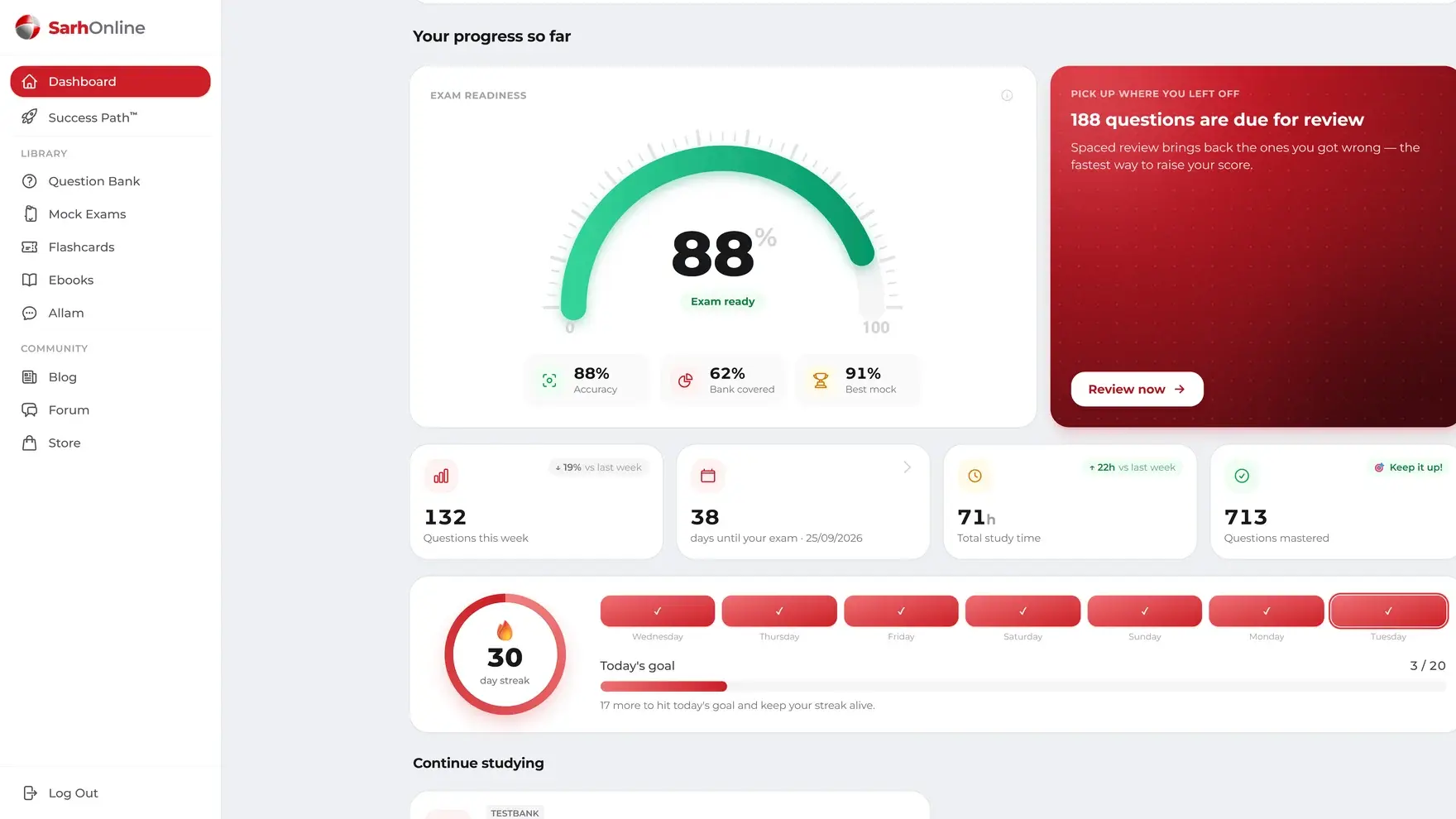
sums up everything
The overall pass rate for the JCPA exam is around 40% — and among those who pass, about 90% studied at Sarh, based on our tracking of our cohorts’ results over the years. The certification is administered by the Jordanian Association of Certified Public Accountants, and it is the only legal key to practicing auditing in the Kingdom.
Why study JCPA with Sarh?
A difficult exam with an overall pass rate that does not exceed 40% — the difference is made by the curriculum you study from and who stands by you until exam day.
The only certification with the official audit seal
JCPA is uniquely the legal key to practicing auditing in Jordan.
The first specialized center
Sarh is the first specialized center for qualifying Jordan Certified Public Accountants.
Seven Arabic books
A complete Arabic curriculum prepared by the Sarh team, covering all exam papers.
90% of those who pass are our students
The overall pass rate is around 40%, and 90% of those who pass studied with us.
Training slides prepared by Sarh
Summaries and slides that condense the curriculum and focus on what actually comes in the exam.
Exam-style question bank written by Sarh
More than 4,000 questions in Arabic on the SarhOnline platform, with an explanation for each question.
Curriculum — seven books in Arabic
You don’t need foreign references or translation. The curriculum is fully in Arabic, prepared by the Sarh team, and updated for the 2026 edition.
A complete library in your hands
Seven parts that fully cover both exam papers — from financial accounting and auditing standards to income and sales tax laws and the legislation governing the profession.
- Fully in Arabic — explanations and terminology in your language, with no language barrier.
- 2026 edition — updated in line with the latest applicable legislation and standards.
- Designed for the exam — organized according to what actually appears in JACPA papers.
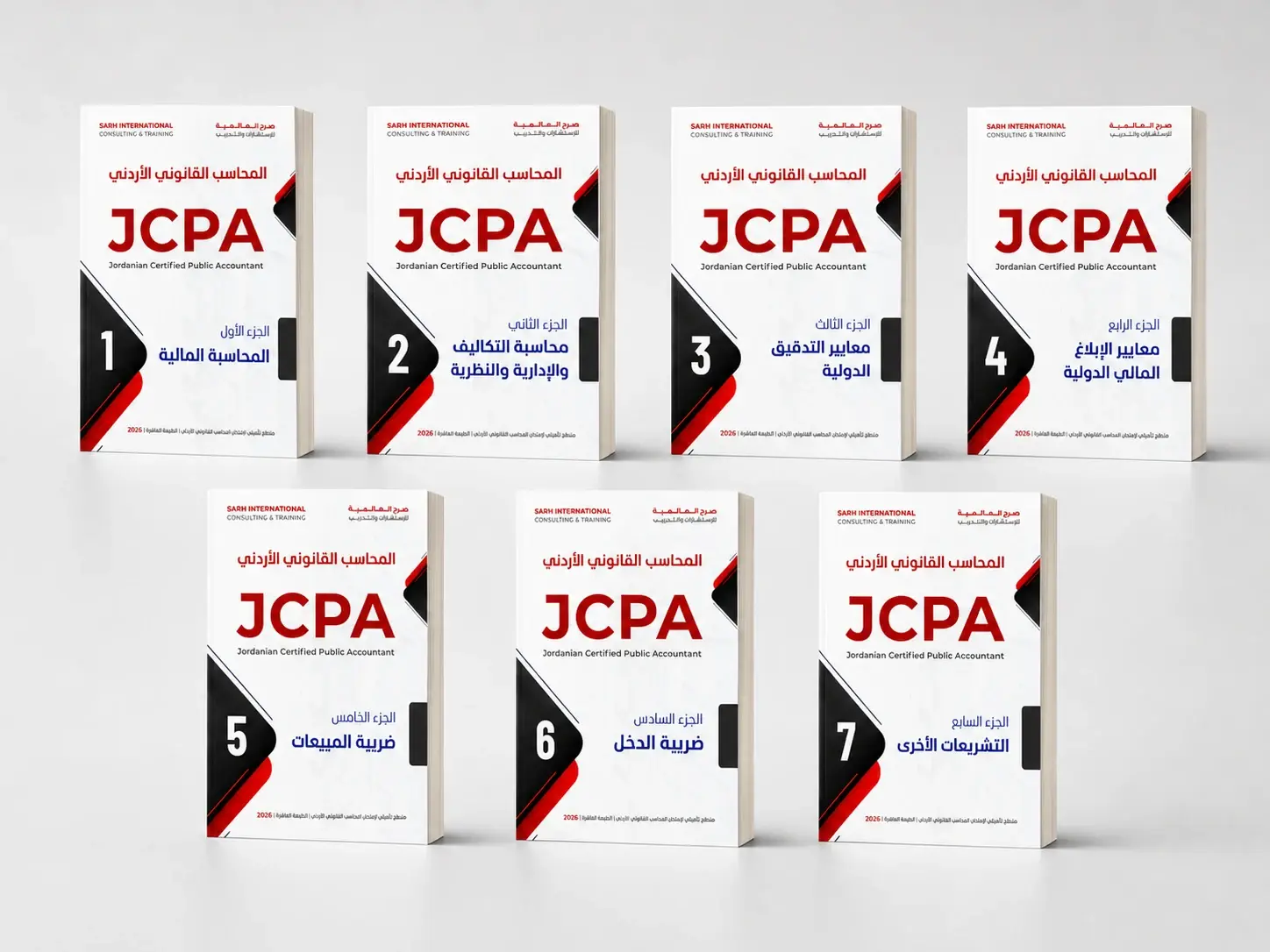
Paper One — Legislation three parts
| Part | Title | What it covers |
|---|---|---|
| Part Five | Sales Tax | The General Sales Tax Law and its applications. |
| Part Six | Income Tax | The Jordanian Income Tax Law and its treatments. |
| Part Seven | Other Legislation | The Companies Law and the rest of the legislation governing the profession. |
Paper Two — Financial four parts
| Part | Title | What it covers |
|---|---|---|
| Part One | Financial Accounting | The foundation on which the remaining parts are built: financial statements and their accounting treatments. |
| Part Two | Cost, Managerial, and Theoretical Accounting | Cost systems, managerial accounting, and the theoretical framework of the profession. |
| Part Three | International Auditing Standards | International auditing standards and their practical applications in the profession. |
| Part Four | International Financial Reporting Standards | IFRS standards and their impact on preparing financial statements. |
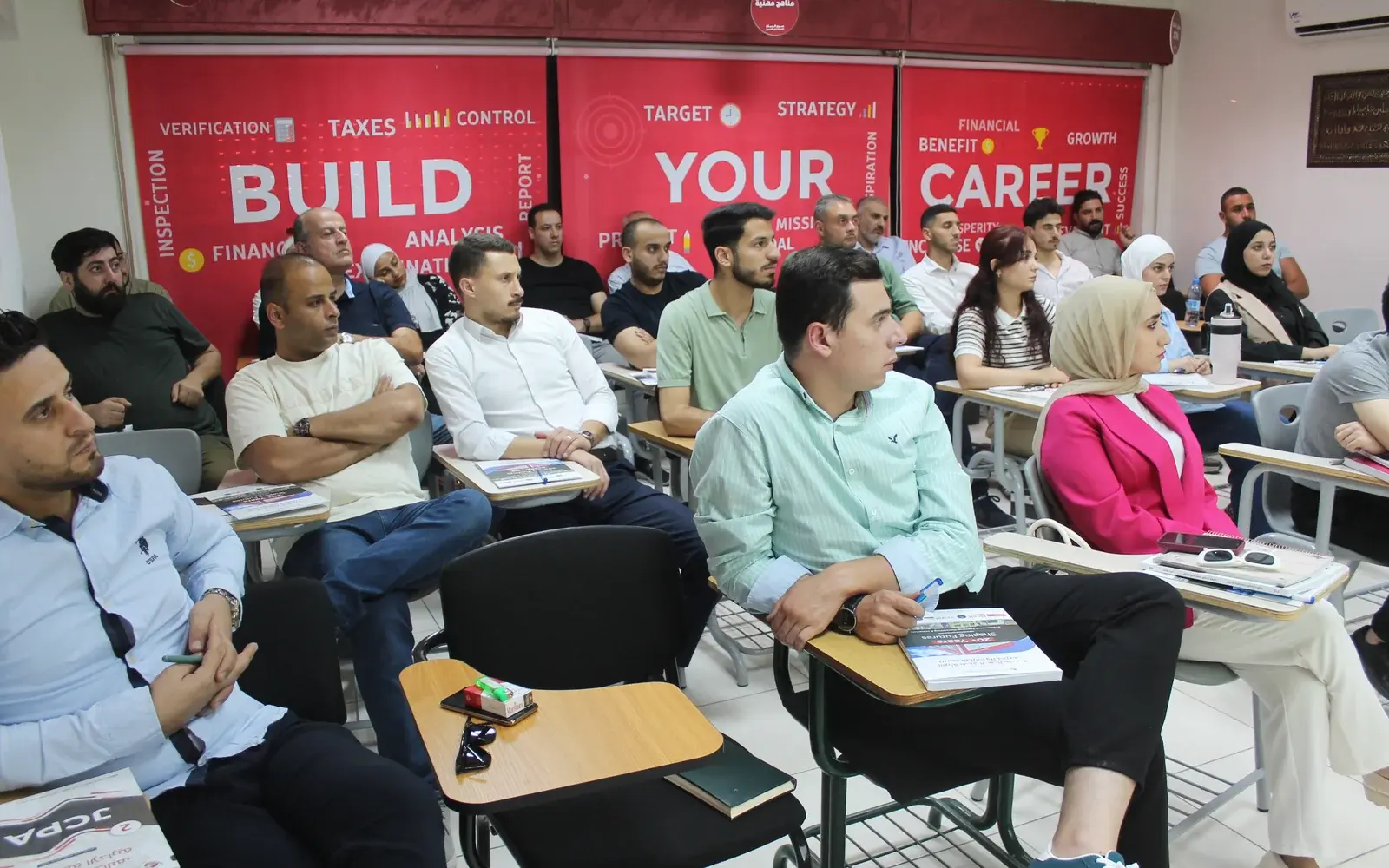
Attend in the way that suits you
The same lectures, the same trainer, and the same materials — only the place you attend changes. Most of those who study with us are employed, so the schedule is built around that.
- In person — interactive lectures at Sarh headquarters, with live discussion and in-class question solving.
- Live online — the same live stream at its scheduled time, with full interaction with the instructor and the group.
- Lecture recordings — if you can’t attend, you receive the recording and it remains available for one year.
SarhOnline platform and Allam
When you register, you receive an account on the SarhOnline platform — more than a question bank: a complete preparation system that tells you exactly where you stand with the exam at every moment.
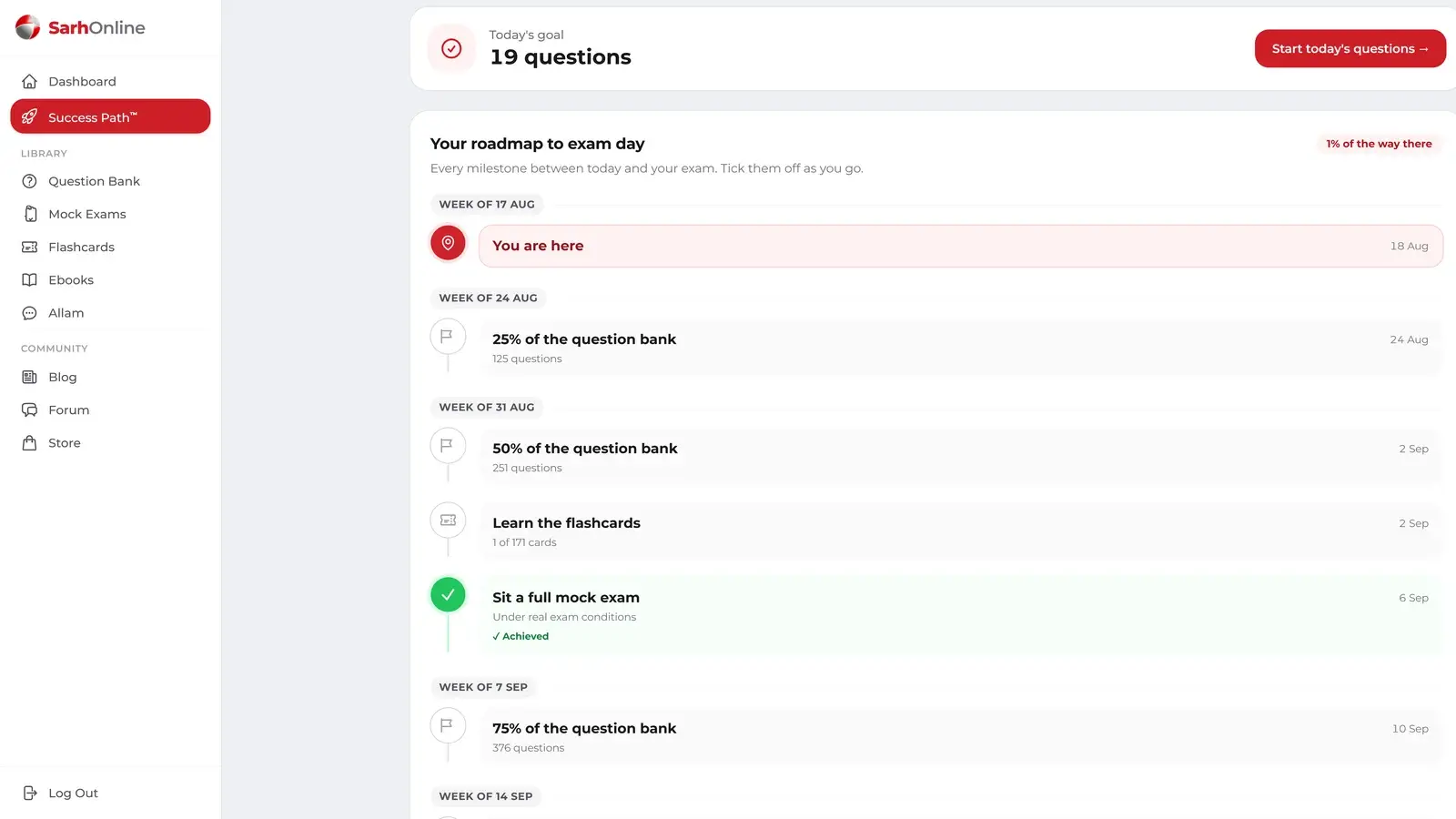
Know exactly where you stand with the exam
A weekly plan built around your exam date and your solving speed, plus a readiness indicator that measures your accuracy and coverage of the question bank and your best mock score, and spaced review that brings back the questions you got wrong right when you’re about to forget them.
Explains in Arabic, and corrects your writing like an examiner
Allam is built on the JCPA books and Sarh’s question bank, not on general information. Write your written answer as you will in the exam, and it gives you a score out of 100 with deduction reasons and improvement points.
- Explains any question or concept in Arabic, step by step.
- Corrects written answers and practical cases.
- A study plan that adapts to your pace and weak points.
Illustrative example
Allam — JCPA Assistant
Ask it in Arabic about any concept or question, it corrects your written answers, and builds a study plan that changes as you progress.
Explanation with every question
Not just an answer key: every question explains why the answer is correct and how to reach it in the exam.
Review Cards
2,215 cards distributed across seven sets for quick, spaced review before the exam.
Readiness Indicator
Your readiness rate and study streak, plus reports that show strong and weak topics.
Simulation Exams
Mock tests with an interface that simulates the Association’s exam in design, timing, and the ability to flag questions for review.
Build your own test
Choose the section, topic, number of questions, and duration — or redo what you previously got wrong.
Exam information
Everything you need to know before you apply, from the Association’s requirements to the format of the two papers.
| Organizing body | The Jordanian Association of Certified Public Accountants, responsible for regulating the profession and the exam. |
| Application requirements | A bachelor’s degree or diploma in accounting, or equivalent. |
| Exam date | Two sessions per year, in months 6 and 12. |
| Exam location | Princess Sumaya University halls (computer-based). |
| Exam papers | Two papers: Legislation and Financial. |
| Exam fee | 125 Jordanian dinars per paper, separate from the course fee. |
| Question types | Multiple-choice and essay questions, three hours per paper. |
| Pass rate | The overall rate is around 40%, and Sarh students make up 90% of those who pass. |
Past JCPA exam papers
Exam papers issued by the Licensing Committee under the Higher Commission for Public Accounting — published here for free for every candidate, without registration.
Paper One — Legislation 6 papers
Paper Two — Financial 7 papers
Everything you need in one place
The course, the curriculum, and the question bank — you can get them together or each one separately.
The full JCPA course
153 training hours in person or online, with the curriculum, slides, and question bank.
The curriculumThe seven books
A complete JCPA curriculum in Arabic prepared by Sarh, 2026 edition.
PracticeElectronic Question Bank
More than 4,000 questions in Arabic with an explanation for each question, plus 2,215 review cards.
Certification plan
From the first lecture to the official audit seal, step by step.
Enroll in the course
You receive the seven books in print, the training slides, and the online question bank.
Attending lectures
153 hours covering both exam papers, in person or online.
Solving past sessions
You practice with more than 4,000 questions, exam simulation, and past session papers.
Applying for the exam
At Princess Sumaya University, in the June or December session.
Official audit seal
After passing both papers, you complete the licensing requirements set by the licensing body, including Jordanian nationality, to receive your licence to practise auditing.
Those who passed with us
Accountants ranging from new graduates to audit firm owners with over 17 years of experience — all of them passed through here.
I graduated three years ago, and after working for a year I decided to start the JCPA certification. At first, I heard it was difficult and challenging, so I tried to study on my own, but honestly it was hard. Then I enrolled at Sarh Center, and the difference was huge—especially with attending the lectures and following up with the instructors, and any question was resolved immediately. I sat the exam the first time and didn’t have luck; I was close to passing with 62%. But the second time I focused more on solving questions and reviewing, and thank God I passed. Honestly, the second experience reinforced the information more, and I recommend any accounting graduate to go for JCPA because it summarizes and strengthens everything they studied at university in a practical, focused way.
 Hamza Freihat
I have nearly 17 years of experience in accounting and financial consulting, and thank God I passed the JCPA exam in both the Financial and Legislation papers. The Financial paper took several attempts before I passed, while I passed Legislation on the first try. In my view, the JCPA certification is the most important in accounting in Jordan, and it represents the culmination of a professional path, given the comprehensive knowledge it provides on both financial and legislative aspects. What always matters is continuing to learn and develop yourself to keep up with the profession’s evolution.
 Mahmoud ShihehHead of Consulting & Accounting Department — Al Madar Audit Company
First, I extend my thanks and appreciation to Sarh Training Center—management, trainers, and staff—all my thanks and appreciation to them. I heard about the JCPA certificate; it’s a Jordanian and important certification. I started the course at Sarh Center for the exam, and thank God I succeeded and passed Paper One and Paper Two on the first attempt. I heard from people that it’s a difficult and impossible certificate, but when a person has determination, nothing is impossible.
 Assaf Al-AssafOwner of Sama Al-Awn International Auditing Firm
FAQs
What applicants ask us most before registering.
How many hours is the course?
153 training hours covering both exam papers.
How much is the exam fee?
125 Jordanian dinars per paper, paid to the body that runs the exam and separate from the course fee.
What are the application requirements?
A bachelor’s degree or diploma in accounting, or equivalent.
What is the pass rate?
The overall pass rate is around 40%, and 90% of those who pass are Sarh students.
Is the curriculum in Arabic?
Yes, seven books fully in Arabic prepared by the Sarh team, 2026 edition.
Are there questions from past sessions?
Yes — a question bank with more than 4,000 questions in Arabic with an explanation for each question on the SarhOnline platform, in addition to the past exam papers published for free on this page.
Where and when is the exam held?
At Princess Sumaya University, in months 6 and 12 each year.
What is the exam format?
Two papers — Legislation and Financial — with multiple-choice and essay questions, three hours per paper.
Are lecture recordings available?
Yes, if you can’t attend, you receive the recording and it remains available for one year.
How much does the JCPA course cost?
Price before discount 640 JOD · 595 JOD in instalments · 540 JOD cash. The course fee is separate from the exam fee of 125 JOD per paper, paid to the association and subject to its fees at registration. The current cohort’s fee appears in the dates card above.
Start where 90% of those who pass started
The exam is difficult, but not impossible. What you need is a complete Arabic curriculum, past session questions, and an instructor who has supported hundreds of candidates before you.
Practise free on the Sarh Online platform:

